
If you’ve read anything about marketing this year, you’ve probably seen a new set of acronyms. GEO. AEO. Sometimes AIO, LLMO or “AI SEO”. Some agencies are selling them as brand-new services. Others insist it’s all just SEO with a new name.
The truth sits in between. Here’s what each term means, how they fit together, and what your business should actually do about it.
The short answer
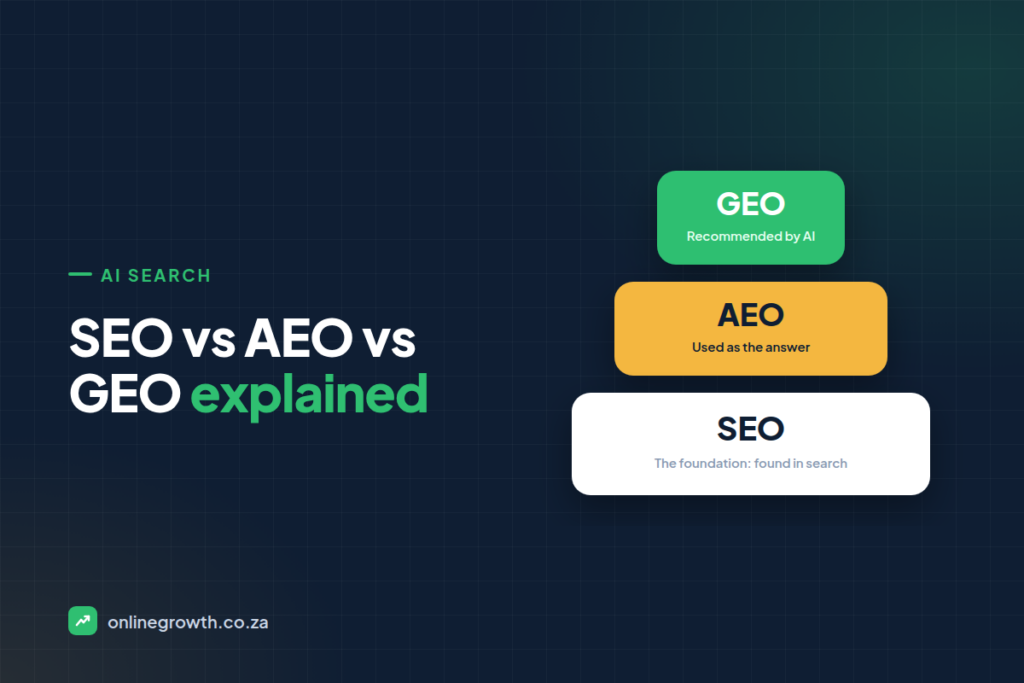
- SEO gets your website found in search engines.
- AEO gets your content used as a direct answer.
- GEO gets your business mentioned and recommended by AI tools.
They overlap heavily. Think of them as three layers of the same job, not three separate projects.
SEO: Search Engine Optimisation
What it is: Improving your website and online presence so you rank higher in search engines like Google and Bing.
What it involves:
- Technical health: a fast, mobile-friendly, secure website that search engines can read.
- Relevant content: clear pages that match what people search for.
- Authority: links and mentions from other trusted websites.
- Local SEO: a complete Google Business Profile, consistent listings and reviews.
How you measure it: Rankings, organic traffic, and the enquiries and sales that traffic produces.
Does it still matter? Absolutely. It’s the foundation for everything else. AI tools and answer features draw heavily on content that search engines already trust.
AEO: Answer Engine Optimisation
What it is: Structuring your content so search engines and assistants can lift it straight into an answer. That includes Google’s featured snippets, “People also ask” boxes, AI Overviews and voice assistants.
What it involves:
- Writing in a question-and-answer format where it makes sense.
- Putting the direct answer first, then the detail.
- Using clear headings, lists and tables.
- Adding FAQ sections and structured data (schema) so machines understand the content.
How you measure it: Appearing in featured snippets and AI Overviews, and being cited as a source.
Example: A dental practice publishes a page titled “How long does teeth whitening last?” The first two sentences answer the question directly. Google is far more likely to use that answer, and credit the practice, than a page that buries it in paragraph six.
GEO: Generative Engine Optimisation
What it is: Improving how visible and well-represented your business is in AI-generated answers from tools like ChatGPT, Gemini, Perplexity, Microsoft Copilot and Google’s AI Mode.
What it involves:
- Entity clarity: making sure AI tools understand exactly who you are, what you do and where, with consistent details across the web.
- Reputation: reviews and positive mentions on credible third-party sites.
- Citable content: specific, factual content with statistics, examples and expert insight that AI tools can reference.
- Presence where AI looks: directories, industry bodies, media coverage and community platforms.
How you measure it: Whether your business is mentioned when you ask AI tools your customers’ questions, how it’s described, and how much traffic arrives from AI tools.
The key difference: SEO is mostly about your website. GEO is about your whole online footprint. An AI tool might recommend you based on your reviews, a news article and a directory listing, not just your homepage.
How they fit together
Here’s a simple way to picture it:
| SEO | AEO | GEO | |
|---|---|---|---|
| Goal | Rank in search results | Be the answer | Be recommended by AI |
| Main focus | Your website | Your content structure | Your whole online reputation |
| Where it shows | Google and Bing results | Snippets, AI Overviews, voice | ChatGPT, Gemini, Perplexity, AI Mode |
| Key measure | Rankings and traffic | Featured answers | AI mentions and AI traffic |
Most of the work overlaps. A clear, well-structured service page with an FAQ section helps all three. A strong review profile helps local SEO and GEO. Consistent business details help everything.
Which ones should your business focus on?
If your website is weak or your listings are messy: start with SEO. Fix the foundations first. There’s no point optimising for AI answers if search engines can’t read your site or your phone number is different on every directory.
If your foundations are solid: add AEO. Restructure key pages and articles so they answer questions directly, and add FAQ sections.
If you’re in a competitive or high-value market: invest in GEO. Build your reputation beyond your website, earn mentions and reviews, and track how AI tools describe you.
For most South African SMEs, the right answer is a sensible mix, weighted towards fixing the foundations first.
A warning about “GEO-only” services
Be cautious of anyone selling GEO as a replacement for SEO, or promising guaranteed placement in ChatGPT. Nobody can guarantee what an AI tool says. And because AI tools rely so heavily on the same trust signals as search engines, GEO without solid SEO is building on sand.
Equally, be cautious of anyone who says AI doesn’t change anything. It does. The way people search, the questions they ask and the number of clicks websites receive have all shifted.
The bottom line
Don’t get lost in the acronyms. The goal is the same as it’s always been: be the easiest business for your customers to find, understand and trust. In 2026, that means showing up in search results, in direct answers and in AI recommendations.
Want to know where you stand? Start with our free keyword ranking scan, then read our full guide: The New SEO Playbook: How Search Works in 2026.
Frequently asked questions
Is GEO replacing SEO? No. GEO builds on SEO. AI tools lean on the same trust and relevance signals that search engines use, so strong SEO makes GEO far easier.
What does AEO stand for? Answer Engine Optimisation. It means structuring your content so search engines and assistants can use it as a direct answer.
Do I need a separate agency for GEO? Not usually. Look for an SEO partner who understands AI search and includes it in their strategy, rather than treating it as a separate product.
How can I check my GEO visibility? Ask ChatGPT, Gemini, Perplexity and Google’s AI Mode the questions your customers would ask. Note whether you’re mentioned, how you’re described, and who gets named instead.