
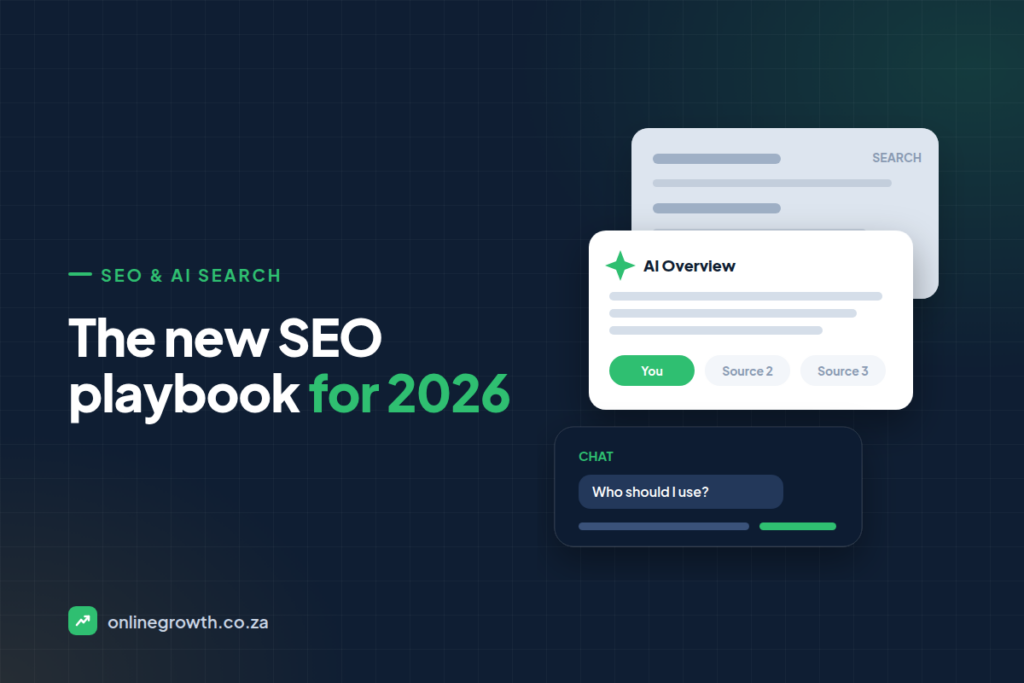
For twenty years, SEO had a fairly simple goal: get your website onto page one of Google, ideally in the top three results, and collect the clicks.
That goal hasn’t disappeared, but it’s no longer the whole game. In 2026, a customer looking for a physio, a guesthouse, an accountant or a new pair of running shoes might:
- read an AI-generated summary at the top of Google and never scroll down
- have a back-and-forth conversation with Google’s AI Mode
- ask ChatGPT, Gemini or Perplexity for a shortlist
- search on TikTok, Instagram or YouTube
- and yes, still click a normal Google result
Each of these works a little differently. This guide explains how search works now, what the new acronyms actually mean, and the practical playbook we follow for our clients at Online Growth.
Part 1: What has actually changed
Google now answers before it sends you anywhere
Google’s AI Overviews appear at the top of a large share of searches, especially questions and research-style queries. One industry study this year found them on the vast majority of business-related searches it tracked. The summary pulls information from several websites and shows a few source links.
For the searcher, that’s convenient. For businesses, it means fewer clicks. Pew Research found that people clicked a traditional search result in about 8% of visits when an AI summary appeared, compared with about 15% when it didn’t.
AI Mode turns search into a conversation
Google’s AI Mode goes further. Instead of a list of results, it gives a conversational answer and lets people ask follow-up questions. At its I/O conference in May 2026, Google said AI Mode had passed a billion monthly users, and it has rolled out widely, including to South African users.
Queries in AI Mode are longer and more specific. People don’t type “physio Cape Town”. They ask “which physio in the southern suburbs is good with running injuries and open on Saturdays?” The businesses that get named are the ones whose information clearly answers that kind of question.
AI assistants are the new word of mouth
ChatGPT now has hundreds of millions of weekly users, and “who should I use for…” is one of the most common things people ask it. When search is involved, these tools look up live web pages and then recommend a handful of businesses, usually with links.
That recommendation carries weight. It feels like advice from a knowledgeable friend, not an advert. Data from Adobe this year suggests visitors who arrive from AI tools convert noticeably better than average, which makes sense: by the time they click, they’ve already been told you’re a good fit.
Search now happens everywhere
Younger customers in particular search on TikTok and Instagram. Shoppers research on YouTube. B2B buyers ask colleagues on LinkedIn and read Reddit threads. “Search” is no longer one box on one website.
What hasn’t changed
Here’s the part that often gets lost in the hype: the fundamentals still matter, arguably more than ever. AI tools build their answers from web content. The pages they tend to pull from are largely the ones search engines already consider relevant and trustworthy. A business with a weak website, inconsistent details and no reviews won’t suddenly be recommended by ChatGPT.
Part 2: The acronyms, in plain English
You’ll see three terms used, often interchangeably. Here’s how we think about them.
SEO (Search Engine Optimisation) Making your website rank in search engines. Technical health, relevant content, links from other sites, and a strong Google Business Profile for local businesses. This is still the foundation.
AEO (Answer Engine Optimisation) Structuring your content so it can be lifted directly into an answer: featured snippets, AI Overviews, voice assistants. Think clear questions, direct answers and well-organised pages.
GEO (Generative Engine Optimisation) Making your business visible and recommended in AI-generated answers from tools like ChatGPT, Gemini, Perplexity and Google’s AI Mode. GEO is less about one page ranking, and more about whether AI tools understand, trust and mention your business across many sources.
In practice, these aren’t three separate services. They’re layers of the same job: being the most findable, understandable and trusted option for the questions your customers ask.
Part 3: How AI tools decide who to mention
Nobody outside Google or OpenAI knows the exact recipe. But research and testing point to consistent patterns. AI tools favour businesses and content that are:
- Easy to verify. Your name, address, phone number and services match across your website, Google Business Profile, directories and social profiles.
- Clearly described. Each service has its own page explaining what it is, who it’s for, where you offer it and what it costs.
- Well reviewed. A healthy flow of recent, genuine reviews on Google and relevant platforms.
- Mentioned by others. Industry associations, local news, directories, supplier sites and community discussions (Reddit is one of the most-cited sources across AI platforms).
- Useful and specific. Content that answers real questions directly, with facts, figures and clear explanations.
- Fresh. Active businesses that update their information and publish regularly.
Notice that nothing on that list is a trick. AI search rewards the same things good customer service does: clarity, consistency and a good reputation.
Part 4: The Online Growth playbook
This is the approach we use with clients. You can use it as a checklist for your own business.
Step 1: Fix the foundations
Before anything else, make sure search engines and AI tools can read your site and trust your details.
- Your website loads fast on mobile and has no technical errors blocking search engines.
- Your name, address and phone number are identical everywhere they appear online.
- Your Google Business Profile is complete, accurate and active.
- Your site has structured data (schema) that tells machines what your business is, where it is and what it offers.
Step 2: Build one clear page for every service and location
The single most common gap we see is one vague “Services” page trying to cover everything. Every important service deserves its own page that answers:
- What is it?
- Who is it for?
- Where do you offer it?
- What does it cost, or how is it priced?
- What do customers usually ask about it?
This gives both Google and AI tools something specific to match to a specific question.
Step 3: Write answer-first content
For blog posts and guides, lead with the answer. If the question is “How long does physiotherapy for a sprained ankle take?”, the first paragraph should answer it, then explain the detail. Use clear headings, short paragraphs, lists and tables. Include figures and cite where they come from. This makes your content easy for AI tools to quote, and easy for people to read.
Step 4: Build topical authority
One article on a topic doesn’t make you an authority. A set of connected articles does. We plan content in clusters: one in-depth guide on a core topic, supported by several focused articles that link back to it. Ten genuinely useful articles on your specialism will do more than a hundred thin ones.
Step 5: Earn mentions beyond your website
AI tools look for consensus. What do other credible sources say about you?
- Get listed on relevant industry and local directories.
- Join and be visible in professional associations.
- Earn coverage in local and trade media.
- Encourage reviews on Google and platforms relevant to your industry.
- Where appropriate, take part in genuine community discussions.
Step 6: Measure what matters now
Traditional reports focus on rankings and traffic. Those still matter, but they miss part of the picture. We also track:
- AI visibility: is your business mentioned when we ask AI tools your customers’ questions?
- AI referral traffic: visits from ChatGPT, Perplexity, Gemini and similar tools, tracked in Google Analytics.
- Branded search growth: more people searching your name is often a sign that AI tools and other channels are recommending you.
- Enquiries and revenue: the numbers that actually pay the bills.
Part 5: What this looks like in different industries
The principles are the same everywhere, but the priorities shift depending on how your customers search.
Medical and allied health practices
Patients ask very specific questions: “Which GP near me is open on Saturdays?”, “Which dentist in Umhlanga accepts Bonitas?”, “Is there a paediatric physio in Pretoria East?” AI tools can only recommend you for what they can verify. Put hours, medical aids accepted, services, languages spoken and booking options clearly on your website and Google Business Profile. Publish patient education content that answers common questions. And keep everything factual and within HPCSA advertising rules. Clear, accurate information is exactly what those rules encourage.
Tourism and hospitality
Travellers increasingly plan trips with AI: “What should we do in the Garden Route with teenagers?”, “Where can we stay near Knysna with a pool that’s dog-friendly?” The businesses that get named tend to have strong reviews across Google and travel platforms, listings on tourism sites, and pages that clearly describe the experience, location, duration, price and who it suits. Seasonal and event-based content (“things to do in Plett in December”) helps too.
E-commerce
Shoppers now ask AI tools to compare products and suggest options within a budget. AI shopping features rely on clean product data: detailed descriptions, specifications, prices, stock, delivery information and reviews. Well-structured product feeds (the same ones you use for Google Shopping) and product schema matter more than ever. Category pages that explain the differences between options, not just list them, are more likely to be cited.
Professional services
For attorneys, accountants, financial planners and consultants, AI tools lean heavily on expertise. Detailed service pages, articles that answer real client questions, named authors with credentials, and mentions in professional bodies and industry media all help. People asking “which attorney in Joburg handles cross-border estates?” want specialists, so be specific about what you do and don’t do.
Part 6: A 90-day plan to get started
If this feels like a lot, here’s a practical order of work.
Days 1–30: Get the foundations right
- Run a technical check of your website: speed, mobile usability, indexing and security.
- Audit your business details across the web and fix every inconsistency.
- Complete and update your Google Business Profile.
- Test 10 customer questions in ChatGPT, Gemini, Perplexity and Google’s AI Mode. Record who gets named. This is your baseline.
- Set up proper conversion tracking and an AI referral report in Google Analytics.
Days 31–60: Build clear, answer-first pages
- Create or rewrite a dedicated page for each core service or product line.
- Add FAQ sections based on real customer questions.
- Add structured data (schema) for your business, services, FAQs and reviews.
- Start a steady, guideline-friendly process for asking customers for reviews.
Days 61–90: Build authority and measure
- Publish your first content cluster: one in-depth guide and three to four supporting articles.
- Get listed on the most relevant industry and local directories.
- Pitch one story or expert comment to local or trade media.
- Re-run your AI question test and compare it with your baseline.
After 90 days, you’ll have a solid foundation and a clear picture of what’s working. From there, it’s about consistency: publishing, earning mentions and keeping your information current.
Part 7: What to stop doing
Some tactics were already weak. Now they’re a waste of money.
- Publishing large volumes of generic AI-written content. AI tools already know the generic answer. They’re looking for sources with something specific to add.
- Keyword stuffing pages or your Google Business Profile name.
- Buying links or reviews. Google is actively penalising this, including pausing reviews on offending profiles.
- Chasing one ranking while ignoring the enquiries it produces.
- Relying on a single channel. Search now spans Google, AI tools and social platforms.
What this means for South African businesses
There’s an opportunity here. Many South African businesses, especially local and specialist ones, still have thin websites, inconsistent listings and no content strategy. AI tools are most likely to name specific businesses for local questions, and competition for those answers is often lower than in larger markets.
The businesses that move now, by getting their foundations right, building clear service pages and earning a strong reputation online, will be the ones AI tools recommend while their competitors are still wondering where their traffic went.
Where to start
The first step is knowing where you stand. Our free keyword ranking scan shows which searches your business currently ranks for, which is the foundation that AI visibility builds on.
If you’d like us to also check what ChatGPT, Gemini and Google’s AI Mode say about your business today, get in touch.
Frequently asked questions
Is SEO dead because of AI? No. AI tools build their answers from web content, and they lean on the same signals SEO has always valued: relevance, quality and trust. SEO is the foundation that GEO builds on.
What is the difference between SEO and GEO? SEO focuses on ranking your website in search results. GEO focuses on getting your business mentioned and recommended in AI-generated answers. They overlap heavily, and the best results come from doing both.
Can I pay to appear in ChatGPT or Google’s AI answers? You can’t pay for organic recommendations in ChatGPT. Google is introducing ads in and around its AI experiences, but organic AI visibility is earned through a strong, consistent and trusted online presence.
How do I know if AI tools recommend my business? Ask them. Test the questions your customers would ask in ChatGPT, Gemini, Perplexity and Google’s AI Mode, and note who gets named. Also check Google Analytics for referral traffic from AI tools.
How long does GEO take to work? Fixing listings and filling in your Google Business Profile can help quickly. Building content, reviews and third-party mentions is an ongoing effort measured in months, just like traditional SEO.
Related reading: SEO vs AEO vs GEO, Your traffic dropped but your leads didn’t, How to write content AI tools quote, Do you need an llms.txt file?, Is ChatGPT recommending your competitors?