
It’s one of the most common conversations we’ve had with business owners this year.
“Our website traffic is down. Something’s wrong.”
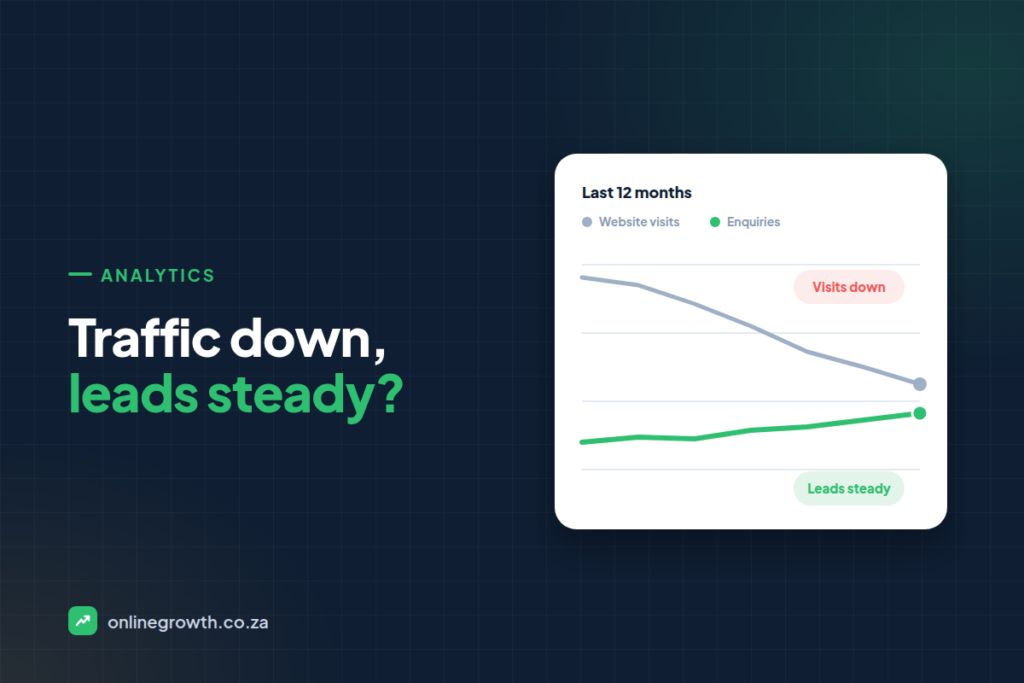
Then we look at the numbers together. Visits are down, sometimes significantly. But enquiries, bookings or sales are steady. Occasionally they’re even up.
So what’s going on? And should you be worried?
What’s happening: people get answers without clicking
Google now shows AI-generated summaries, called AI Overviews, at the top of a large share of searches. They answer the question directly on the results page, drawing on several websites.
For research-style searches, that means many people get what they need without clicking anything. Pew Research found that when an AI summary appeared, people clicked a traditional search result in about 8% of visits, compared with about 15% when there was no summary. That’s roughly half as many clicks.
Add Google’s conversational AI Mode, and the growing number of people asking ChatGPT or Gemini instead of searching, and it’s no surprise that website visits are falling for many businesses.
Why your leads might be holding steady
Here’s the important part. The clicks you’re losing are mostly the ones that weren’t going to become customers anyway.
Think about who used to visit your site:
- Someone researching “what causes lower back pain” out of curiosity
- A student looking up a definition
- A person comparing general information with no intention of buying yet
Many of those people now get their answer from an AI summary. They never reach your site.
Meanwhile, the people who are ready to act, the ones searching “physio near me open Saturday” or clicking through after an AI tool recommended you, still visit. And they tend to arrive better informed and more likely to convert. Data from Adobe this year suggested visitors arriving from AI tools convert noticeably better than average.
So you may have fewer visitors, but a higher share of the right ones.
When a traffic drop is a real problem
Not every drop is harmless. It’s worth investigating if:
- Enquiries or sales are also falling. That suggests you’re losing visibility where it counts.
- Traffic to your service or product pages is falling, not just blog posts.
- Branded searches are dropping. Fewer people searching your name can mean you’re being recommended less.
- The drop is sudden and sharp. This could point to a technical issue, a Google penalty or a site change that broke something.
What to measure now
If traffic alone doesn’t tell the story, what does? Here’s what we track for clients.
1. Conversions, not just visits
Enquiry forms, calls, WhatsApp clicks, bookings and sales. Make sure these are all tracked properly in Google Analytics 4. If you only track pageviews, you’re flying blind.
2. Conversion rate
If visits fall 20% but enquiries stay flat, your conversion rate has improved. That’s a good sign your traffic quality is rising.
3. Traffic by page type
Split your traffic between informational content (blogs, guides) and money pages (services, products, contact). A drop in blog traffic is less concerning than a drop in service-page traffic.
4. AI referral traffic
Visits from ChatGPT, Perplexity, Gemini, Copilot and similar tools show up as referral traffic in GA4. It’s usually small but growing, and it’s high quality. Set up a simple report or segment to watch it.
5. Branded search
Track how many people search your business name in Google Search Console. Growth here often means AI tools, word of mouth and other channels are sending people your way.
6. Impressions vs clicks in Search Console
If impressions are stable or rising but clicks are falling, that’s the AI Overview effect. You’re still being seen; people just aren’t clicking as often.
7. AI visibility
Regularly ask AI tools the questions your customers ask, and record whether you’re mentioned. This is the new “ranking report”.
What to do about it
Don’t panic and don’t chase old numbers. Pouring money into getting traffic back to 2023 levels misses the point. Focus on the visitors who matter.
Strengthen your money pages. Make sure every service or product page is clear, fast, specific and easy to act on. These pages still get clicked by people who are ready to buy.
Make your content citable. If AI Overviews are answering questions using other websites’ content, make yours the source they use. Put direct answers first, include specific facts and figures, and structure pages clearly.
Build your reputation beyond your website. Reviews, directory listings and mentions on credible sites all help AI tools recommend you.
Fix your tracking. If you can’t confidently say how many enquiries came from your website last month, fix that first.
The bottom line
Falling traffic isn’t automatically bad news. In 2026, fewer, better-qualified visitors can be worth more than lots of casual ones. What matters is whether your website is still bringing in enquiries and sales, and whether AI tools and search engines still see you as a trusted option.
Not sure what your numbers are telling you? Our free keyword ranking scan shows where you rank today, and we’re happy to look at your analytics with you. Get in touch.
For the bigger picture, read The New SEO Playbook: How Search Works in 2026.
Frequently asked questions
Why is my website traffic dropping in 2026? The most common reason is AI Overviews and AI tools answering questions directly, so fewer people click through. Technical issues, competition and algorithm updates can also cause drops, so it’s worth checking.
Is a drop in website traffic bad for my business? Not necessarily. If enquiries and sales are stable, you’re likely losing low-intent visitors. If conversions are also falling, it needs attention.
How do I see ChatGPT traffic in Google Analytics? In GA4, look at referral traffic under Acquisition. Visits from ChatGPT usually appear with a source like chatgpt.com. You can create a segment grouping all AI tools together.
What is zero-click search? It’s when someone gets their answer on the search results page, from an AI summary or a snippet, without clicking through to any website.