
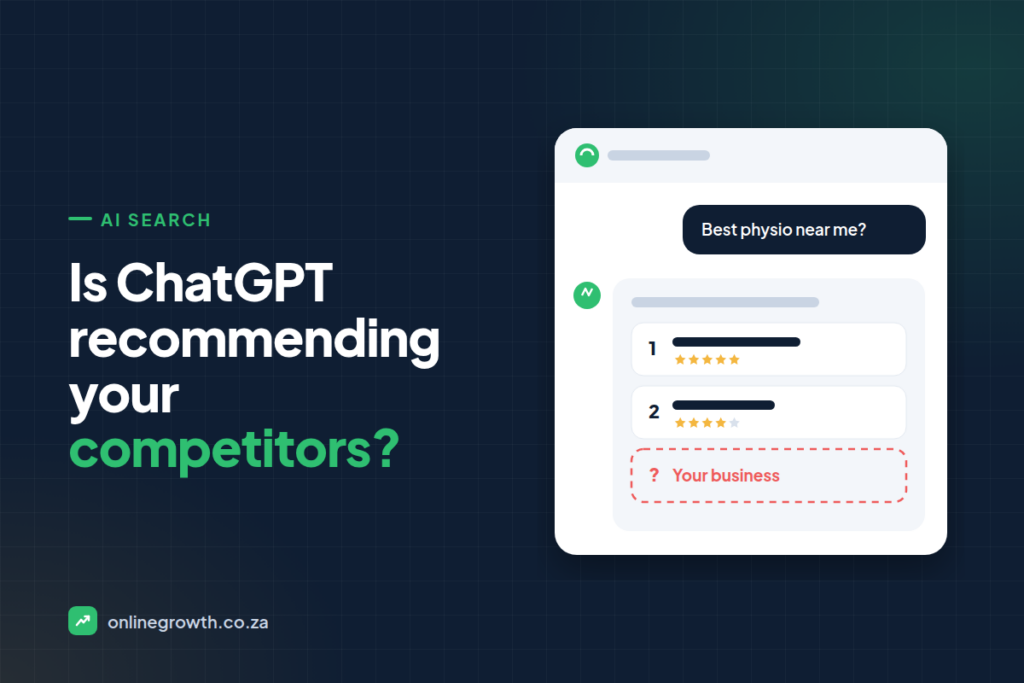
Try something before you read on. Open ChatGPT, or Google’s AI Mode, and ask the question one of your customers would ask. “Who’s a good physio in Durbanville?” “Best wine tour in Stellenbosch?” “Which accountant in Pretoria works with small businesses?”
You’ll usually get two or three names, with a line about each. If yours is one of them, great. If a competitor’s is and yours isn’t, that’s a customer you never knew you lost. They didn’t scroll past you on Google. They were simply never shown you.
Why it matters now
Google is still where most South Africans look for a business. But the results page has changed. AI Overviews sit at the top of a large share of searches, AI Mode turns a search into a conversation, and a growing number of people skip Google entirely and ask ChatGPT.
The common thread is a shortlist. Instead of ten links to compare, people get a few names that an AI has already vetted for them. Ranking on page one still matters. It’s now what gets you considered for that shortlist.
How the AI decides who to name
OpenAI and Google don’t publish their recipe. From testing and from what they do say, though, the pattern is fairly clear. For a “who should I use” question, ChatGPT runs a live web search, reads the pages it finds and writes an answer. It favours businesses it can confirm from more than one source.
That comes down to five things:
- Your details match everywhere. If your website says “Bayside Family Practice” and your Google listing says “Bayside Medical Centre” with an old phone number, the AI can’t be sure they’re the same business.
- You have recent, genuine reviews, on Google and on platforms that matter in your industry.
- Each service has its own page. A single “Services” page gives the AI nothing specific to match against “teeth whitening in Umhlanga”.
- Other credible sites mention you. Industry bodies, local news, tourism sites and supplier listings all act like references.
- Your content answers real questions, and it’s current.
There’s no trick on that list, and that’s the point. These tools are built to recommend the business that looks most clearly real and trusted.
A few industry examples
Medical practices. Patients ask very specific questions: “paediatrician open on Saturdays”, “GP in Claremont that does telehealth”. If your hours, services and medical aids aren’t written on your website and Google profile, the AI can’t match you to them. Practices also have HPCSA rules to work within, which I cover in our guide to marketing a medical practice.
Tourism and hospitality. Travellers plan trips with AI now (“things to do on the Garden Route with teenagers”). The businesses that get named tend to have strong reviews across Google and travel platforms, plus pages that spell out the experience, location, duration and price.
Online stores. Shoppers ask AI to compare products. Detailed product pages, clear delivery information and reviews are what get you into that comparison.
What to do this month
Start with the free fixes. Search your business name and check every listing you can find: name, address, phone number, hours. Correct anything that’s out of date. Then fill in every section of your Google Business Profile, because AI tools read it.
After that, look at your website. Does each of your main services have its own page, written in plain language, with the area you serve? If not, that’s the next job. Add a short FAQ to those pages too. Direct answers to common questions are exactly what AI tools like to quote.
Finally, make asking for reviews a habit, not a campaign. Ask happy customers, reply to every review, and never pay for them. Google has become much stricter about this.
Is this the end of SEO?
No. Most AI answers start with a web search, and the pages they pull from are largely the ones search engines already trust. If your website doesn’t rank for anything, it’s unlikely to be the one an AI picks. What has changed is the cost of weak pages. Thin, copied or keyword-stuffed content was never a good strategy, and now it actively keeps you out of the answers.
If you’d like to know what ChatGPT and Google currently say about your business, ask us to run the test for your industry and area. We’ll show you who gets named and why. If you’d rather start with the basics, our free keyword ranking scan shows where you rank on Google today.
Common questions
Can I pay to be recommended by ChatGPT? No. There’s no way to buy a place in ChatGPT’s recommendations. They come from how consistent, credible and well reviewed your business is across the web.
How long does it take to show up? Fixing listings can help within weeks. Reviews, content and mentions on other sites build up over months, much like traditional SEO.
What’s GEO? Generative engine optimisation: making your business easy for AI tools to understand and recommend. We explain how it relates to SEO in SEO vs AEO vs GEO.
