
Marketing has picked up a new batch of acronyms this year. GEO, AEO, sometimes AIO or “LLM SEO”. Some agencies sell them as brand-new services. Others say it’s all just SEO with a new label.
Neither is quite right. They describe different parts of the same job, and the overlap is large.
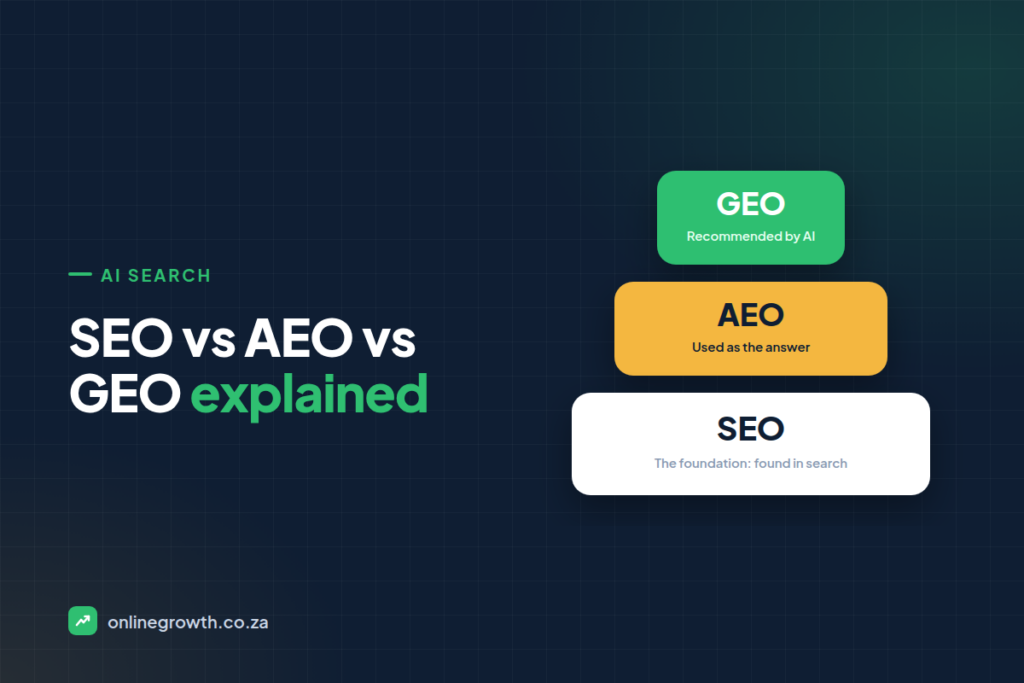
| SEO | AEO | GEO | |
|---|---|---|---|
| Stands for | Search engine optimisation | Answer engine optimisation | Generative engine optimisation |
| The goal | Rank in search results | Be used as the answer | Be recommended by AI tools |
| Mostly about | Your website | How your content is structured | Your reputation across the web |
| Where it shows | Google and Bing results | Featured snippets, AI Overviews, voice assistants | ChatGPT, Gemini, Perplexity, Google AI Mode |
| How you’d measure it | Rankings, traffic, enquiries | Appearing in snippets and AI Overviews | Being named in AI answers, traffic from AI tools |
SEO
This is the foundation: a fast, secure website that search engines can read, pages that match what people search for, links and mentions from other trusted sites, and, for local businesses, a complete Google Business Profile with consistent listings and reviews.
It hasn’t stopped mattering. AI answers draw heavily on content search engines already trust, so a site that doesn’t rank is unlikely to be quoted.
AEO
AEO is about making content easy to lift into an answer. In practice that means writing around real questions, putting the direct answer first, using clear headings, lists and tables, and adding FAQ sections with structured data so machines understand the format.
A dental practice with a page called “How long does teeth whitening last?” that answers the question in its first two sentences is far more likely to be quoted, and credited, than one that buries the answer in paragraph six.
GEO
GEO is the newest and the least understood. It’s about whether AI tools understand who you are and trust you enough to recommend you. That depends on your whole online footprint, not just your homepage: consistent business details everywhere, reviews and mentions on credible third-party sites, content with specific facts and figures, and a presence on the directories, industry bodies and community platforms AI tools read.
An AI might recommend you because of your Google reviews, a news article and a directory listing, without leaning much on your website at all.
Which to focus on
Start with SEO if your website is weak or your listings are messy. There’s little point structuring content for AI answers if search engines struggle to read your site, or your phone number is different on every directory.
Add AEO once the foundations are solid. Restructure your key service pages and best articles so they answer questions directly, and add FAQs.
Invest in GEO if you’re in a competitive or high-value market. Build your reputation beyond the website, keep reviews coming in, earn mentions, and check regularly how AI tools describe you.
For most South African small businesses the right answer is a mix, weighted heavily towards fixing the foundations first.
A word of caution
Be wary of anyone selling GEO as a replacement for SEO, or promising your business will appear in ChatGPT. Nobody controls what an AI tool says, and because these tools rely on the same trust signals as search engines, GEO without solid SEO underneath doesn’t hold up.
Be just as wary of anyone who says AI changes nothing. How people search, what they ask and how often they click through to websites have all shifted.
For the longer version, with a 90-day plan, read the new SEO playbook. If you’d like to see where your business stands, start with a free keyword ranking scan.
