

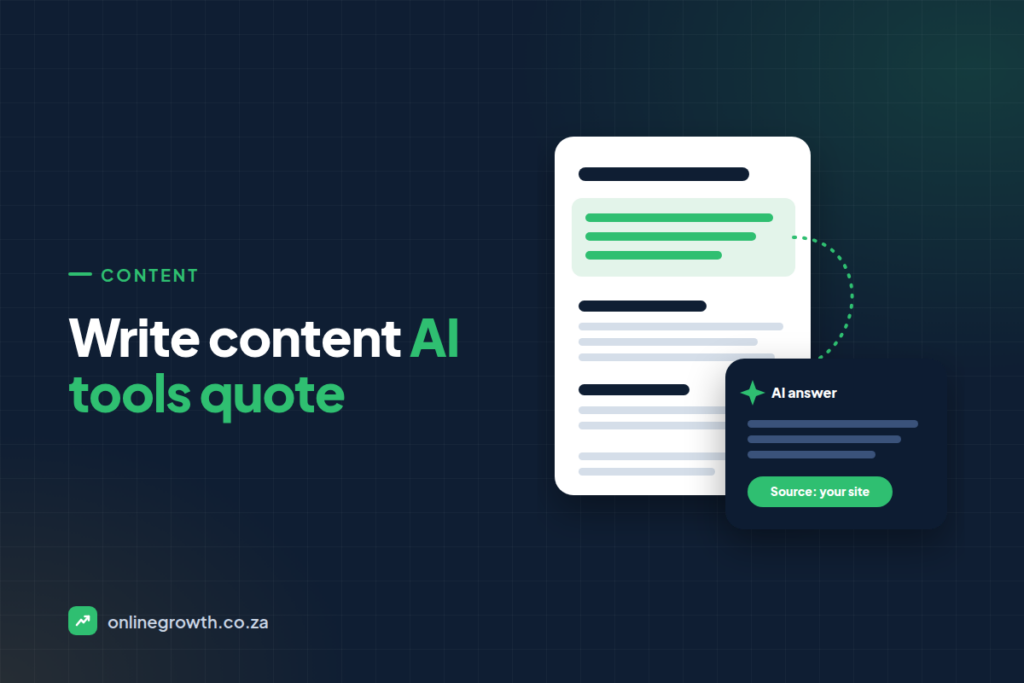
When Google’s AI Overviews or ChatGPT answer a question, they pull from websites. A few pages get quoted and linked. Most don’t.
The pages that get quoted tend to be the ones people find easiest to read anyway: clear, specific, well organised and trustworthy. Writing for AI and writing for customers turn out to be mostly the same job.
There’s research behind this. A study from Princeton and partner universities, the one that coined the term “generative engine optimisation”, tested different ways of editing content. Adding statistics, quotes from credible sources and citations raised visibility in AI answers by up to around 40% in their tests.
Put the answer first
This is the change most business websites need. A lot of pages open with background (“At our practice we believe in holistic care and have served the community since 2005…”) and get to the answer four paragraphs later, if at all. AI tools and busy readers both want it up front.
Before:
Teeth whitening is a popular cosmetic treatment that many of our patients ask about. There are many factors to consider, and every patient is different…
After:
Professional teeth whitening usually lasts between one and three years. How long yours lasts depends mostly on what you eat and drink, whether you smoke, and how you look after your teeth.
Then explain the detail.
Use your customers’ questions as headings
Build pages around real questions, as subheadings, each answered directly underneath. The best source is your own inbox and phone: what do customers ask you every week? Google’s “People also ask” box, your reviews and your Google Business Profile are useful too. A page that answers ten real questions clearly will beat a page of generic marketing copy almost every time.
Be specific
Generic content is invisible to AI tools because they already know the generic answer. They’re looking for something concrete to cite.
| Vague | Specific |
|---|---|
| Our prices are competitive. | Brochure websites start from R10,000. |
| We serve the Garden Route. | We work with businesses in Plettenberg Bay, Knysna, George and Mossel Bay. |
| Recovery times vary. | Most patients are back to light exercise within two to three weeks. |
Back it up
Numbers give AI tools something solid to quote, but always say where they come from and when. A statistic with no source looks unreliable to readers and gives an AI less reason to trust it.
Your own data is even better. Something like “Across the practices we audited this year, [X]% had the wrong weekend hours on Google” is information nobody else has. That’s exactly what AI tools, and journalists, go looking for.
Show who’s behind the content, too. Put a real name and a short bio on articles, share examples from your own work, and quote people who know the subject, including people in your own business. In health, legal and financial topics especially, keep claims accurate and balanced.
Make it easy to scan
Short paragraphs, descriptive subheadings, numbered steps where order matters, tables for comparisons and prices. A short FAQ at the end of key pages is one of the easiest wins available, because each question and answer is a neat, self-contained piece an AI tool can lift. Add FAQ schema so search engines recognise it.
Keep it current
AI tools that search the web lean towards recent, accurate information. Review your most important pages at least once a year, update prices, figures and hours, and show when the page was last updated.
About writing with AI
Using AI tools for research, outlines and first drafts is fine and increasingly normal. Publishing what they produce without changes isn’t. It tends to be generic, it can be wrong, and it adds nothing an AI tool doesn’t already know. Use it to go faster, then add what only you can: your experience, your data, your examples and your opinion.
A useful test before publishing: would you send this page to a customer who asked the question? If not, it isn’t ready.
Before you hit publish
- The first paragraph answers the main question
- Subheadings are real customer questions
- There are specific facts, figures or examples
- Statistics are sourced and dated
- It’s clear who wrote it and why they know
- It’s easy to read on a phone
- There’s a short FAQ, where it makes sense
- You’d happily send it to a customer
Writing content that ranks, gets quoted and brings in enquiries is a big part of our SEO work. If you’d like help with yours, tell us about your business. For how this fits into search as a whole, read the new SEO playbook.
