
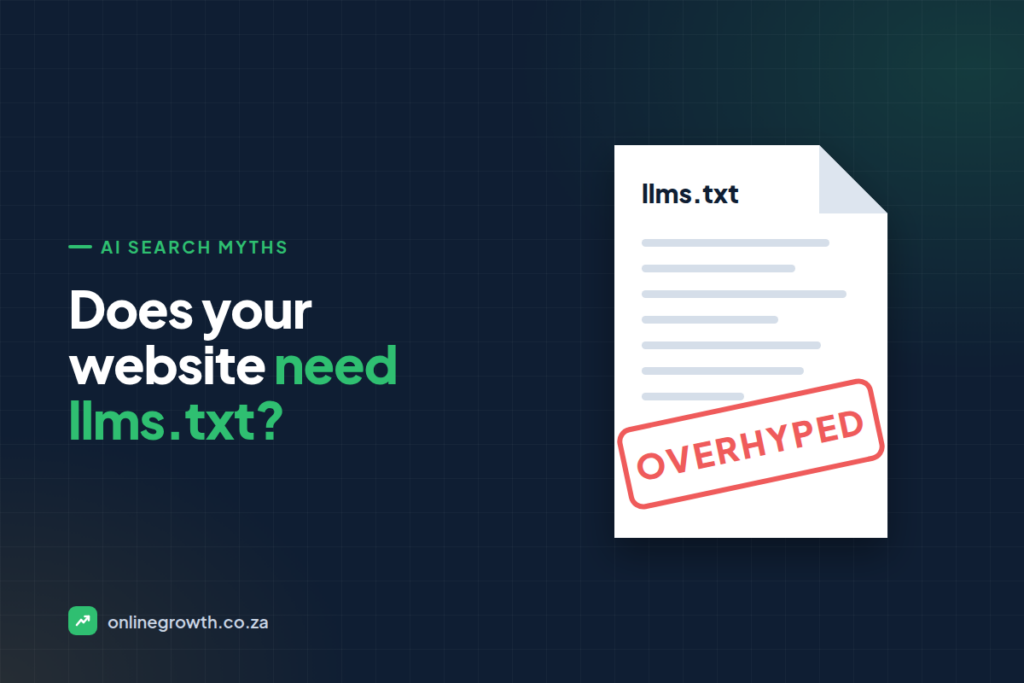
If you’ve spoken to a digital marketing agency this year, there’s a fair chance someone has mentioned llms.txt. It’s often pitched as a must-have for AI search: “Add this file and ChatGPT will understand your business.”
It’s a good example of how quickly myths spread in a fast-moving industry. So let’s look at what llms.txt actually is, whether it works, and whether you should bother.
The short answer
For most South African businesses: it won’t hurt, but it won’t help your visibility in ChatGPT or Google either. There are far better uses of your time and budget.
What is llms.txt?
llms.txt is a proposed standard, first suggested in 2024. The idea is simple: you add a plain text file to your website (at yourwebsite.co.za/llms.txt) that gives AI tools a clean summary of your site and links to your most important pages, written in a format that’s easy for large language models (LLMs) to read.
It’s modelled loosely on robots.txt, the long-established file that tells search engine crawlers which pages they can and can’t access.
On paper, it sounds sensible. The problem is what happens in practice.
Do AI tools actually use it?
This is where the hype falls apart.
Google has said it doesn’t use it. Google representatives have been clear that Search doesn’t support llms.txt and isn’t planning to, with one comparing it to the old keywords meta tag, a feature Google stopped paying attention to years ago.
The major AI crawlers largely ignore it. Analyses of AI crawler traffic published this year found that bots from OpenAI, Anthropic, Perplexity and Google overwhelmingly crawl normal web pages directly, and very rarely request llms.txt files at all.
None of the major AI search products officially relies on it for deciding which businesses to recommend.
In other words, there’s no good evidence that adding an llms.txt file will make ChatGPT, Gemini, Perplexity or Google’s AI Overviews more likely to mention your business.
So why is it being sold?
A few reasons:
- It’s easy to deliver. A text file takes little time to create, and it’s something tangible an agency can point to.
- It sounds technical and new. In a market where business owners are anxious about AI, anything with “AI” attached sells.
- There is a genuine niche use. Some AI coding tools and developer assistants do read llms.txt files, which makes them useful for software companies with technical documentation.
None of that makes it a meaningful visibility tool for a medical practice, a guesthouse, an online store or a law firm.
When llms.txt might make sense
To be fair, there are cases where it’s reasonable to add one:
- Software and SaaS companies with developer documentation, where AI coding assistants may use it.
- Large content or e-commerce sites preparing for AI shopping agents, as a low-cost experiment.
- If it takes an hour and costs nothing extra as part of other work, there’s no harm.
What you shouldn’t do is pay for it as a standalone “AI optimisation” service, or treat it as a substitute for real work.
What actually helps you show up in AI answers
If your goal is to be recommended by AI tools, here’s where the effort genuinely pays off:
- Make your website readable. Fast, mobile-friendly pages that search engines and AI crawlers can access. Check that your robots.txt file isn’t accidentally blocking legitimate crawlers.
- Use structured data (schema). Unlike llms.txt, schema markup is widely supported by search engines and helps them understand your business, services, reviews and FAQs.
- Keep your business details consistent across your website, Google Business Profile and directories.
- Create a clear page for every service. Specific pages are much easier for AI tools to match to specific questions.
- Write answer-first content with specific facts and clear structure.
- Build your reputation. Reviews, directory listings, media coverage and industry mentions all help AI tools trust you.
These aren’t as quick as uploading a text file. But they’re what actually works.
A useful test for any “AI SEO” pitch
When someone sells you an AI search tactic, ask three questions:
- Which AI tools use this, and where is that documented?
- What evidence is there that it improves visibility or enquiries?
- What would you do instead if this didn’t exist?
If the answers are vague, be cautious. Good advice in this space is grounded in how the tools actually work, not in what sounds impressive.
The bottom line
llms.txt is a tidy idea that hasn’t been adopted by the tools that matter most for your business. If it’s added as a free extra, fine. If it’s the centrepiece of an “AI SEO” proposal, ask more questions.
Want an honest view of where your business stands in search and AI results? Start with our free keyword ranking scan, or get in touch and we’ll tell you what’s worth doing, and what isn’t.
For the full picture, read The New SEO Playbook: How Search Works in 2026.
Frequently asked questions
What is an llms.txt file? A proposed plain text file placed on a website to give AI language models a simplified summary of the site and links to key pages.
Does Google use llms.txt? No. Google has stated that Search doesn’t support llms.txt.
Does ChatGPT read llms.txt? There’s no evidence that ChatGPT relies on llms.txt to decide which businesses to recommend. Analyses of AI crawler behaviour show bots mostly read normal web pages directly.
Is llms.txt the same as robots.txt? No. robots.txt is a long-established standard that tells crawlers which pages they can access. llms.txt is a newer, unofficial proposal to summarise content for AI tools.
Should I add llms.txt to my website? It won’t hurt, and it may be useful for software companies with developer documentation. For most businesses, time is better spent on content, structured data, listings and reviews.