
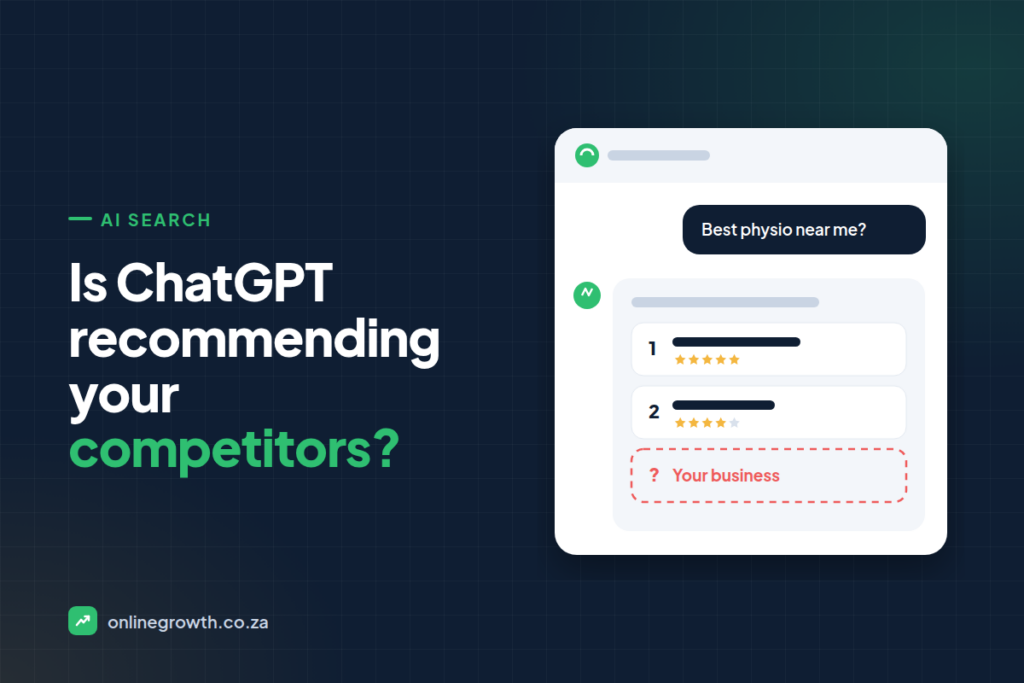
Try this before you read any further. Open ChatGPT, Gemini or Google’s AI Mode and type the question your ideal customer would ask. Something like “Who’s a good physio in Durbanville?”, “Best wine tour in Stellenbosch?” or “Which accounting firm in Pretoria works with small businesses?”
Did your business come up?
If it did, good. If it didn’t, and a competitor did, you’ve just seen one of the biggest shifts in how customers find businesses in 2026. People are no longer only scrolling through ten blue links. They’re asking a question, getting a confident answer with two or three names in it, and picking from that shortlist. If you’re not on it, you’re not in the running.
Why this matters more than it did a year ago
Search hasn’t disappeared. Google is still the biggest source of new customers for most South African businesses. But the way results are shown has changed.
Google now puts AI Overviews at the top of many results pages. ChatGPT, Gemini and Perplexity are being used as research assistants, especially for “who should I use” questions. And industry research published this year suggests that a large share of searches now end without anyone clicking through to a website, because the answer was given on the results page itself.
That changes the goal. It’s no longer only “rank on page one”. It’s “be the business the AI trusts enough to name”.
How AI tools decide who to recommend
Nobody outside OpenAI or Google knows the exact recipe, and anyone who tells you they do is selling something. But the pattern is well understood, and it’s more common sense than magic.
When someone asks a local “who should I use” question, tools like ChatGPT typically run a live web search, read what they find, and put together an answer. They’re looking for businesses they can verify. That means:
- Consistent details everywhere. Your business name, address and phone number should match across your website, your Google Business Profile, directories and social profiles. If one listing says “Dr Smith Family Practice” and another says “Smith Medical Centre” with a different number, the AI is less sure you’re one business.
- Reviews and reputation. A healthy number of recent, genuine reviews on Google and relevant industry platforms signals that real people use you.
- Clear service pages. If your website has one vague “Services” page, the AI has nothing specific to quote. If you have a clear page for each service, with the area you serve, it can match you to specific questions.
- Mentions elsewhere. Being listed or mentioned on credible third-party sites (industry bodies, local directories, news articles, tourism boards, supplier pages) acts like a reference check.
- Fresh, useful content. Businesses that publish helpful, up-to-date content give AI tools something current to draw from.
Notice what’s not on that list: stuffing your pages with keywords, or tricks. AI tools are designed to reward the business that looks most clearly real, relevant and trusted.
What this means by industry
Medical practices. Patients increasingly ask AI tools questions like “paediatrician near me that’s open on Saturdays” or “which GP in Claremont does telehealth?”. If your hours, services and medical aid information aren’t clearly listed on your website and Google profile, the AI can’t match you to those questions. (If you’re a practice, also read our guide to marketing within HPCSA rules, because you have extra considerations.)
Tourism and hospitality. Travellers use AI to plan trips: “things to do in the Garden Route with teenagers” or “best paragliding in Cape Town”. The businesses that get named usually have strong review profiles, listings on tourism sites, and pages that clearly describe the experience, location, duration and price.
E-commerce. Shoppers ask AI to compare products. Clear product descriptions, specifications, pricing, delivery information and reviews all help your products appear in those comparisons.
Professional services. For attorneys, accountants and consultants, AI tools lean heavily on expertise signals: detailed service pages, articles that answer real client questions, and credentials that can be checked.
Six things to do this month
- Run the test yourself. Ask ChatGPT, Gemini and Google (with AI Mode, where available) five questions your customers would ask. Write down who gets named. That’s your real competition.
- Audit your business details. Search your business name and check every listing you can find. Fix anything inconsistent, especially old phone numbers and addresses.
- Fill in your Google Business Profile completely. Services, hours, photos, description, categories. AI tools read this data.
- Give each core service its own page. One page per service, written in plain language, answering the questions people actually ask.
- Build a steady review habit. Ask happy customers for honest reviews as part of your normal process, and reply to them. (Don’t buy reviews or offer incentives. Google is cracking down hard.)
- Add an FAQ section to key pages. Short, direct answers to common questions are exactly the kind of content AI tools like to quote.
Is SEO dead, then?
No. Good SEO is the foundation of AI visibility. Most AI tools start with a web search, and the pages they read are largely the ones that search engines already consider trustworthy. If your site isn’t ranking for anything, it’s unlikely to be the one an AI picks.
What has changed is the bar. Thin pages, copied content and keyword tricks were already a weak strategy. Now they’re a waste of money. The businesses winning in 2026 are the ones that are genuinely clear about who they are, what they do and who they do it for.
Where do you stand?
The first step is knowing where you rank today. Our free keyword ranking scan shows which search terms your business currently appears for, and where the gaps are. It’s the quickest way to see whether search engines, and the AI tools built on them, can find you.
If you’d like a proper look at your AI visibility, including what ChatGPT and Google say about your business today, get in touch.
Frequently asked questions
Can I pay to be recommended by ChatGPT? No. There’s currently no way to buy a place in ChatGPT’s organic recommendations. Visibility comes from being consistent, credible and well-reviewed across the web.
What is GEO? GEO stands for Generative Engine Optimisation. It’s the practice of making your business and content easy for AI tools to understand, trust and cite. It builds on SEO rather than replacing it.
How long does it take to show up in AI answers? It varies by industry and competition. Fixing inconsistent listings and filling in your Google profile can help quickly, while building reviews and content is an ongoing process measured in months.
Does this matter for small local businesses? Yes, arguably more than for big brands. Local questions are where AI tools are most likely to name specific businesses, and there’s often less competition for them.